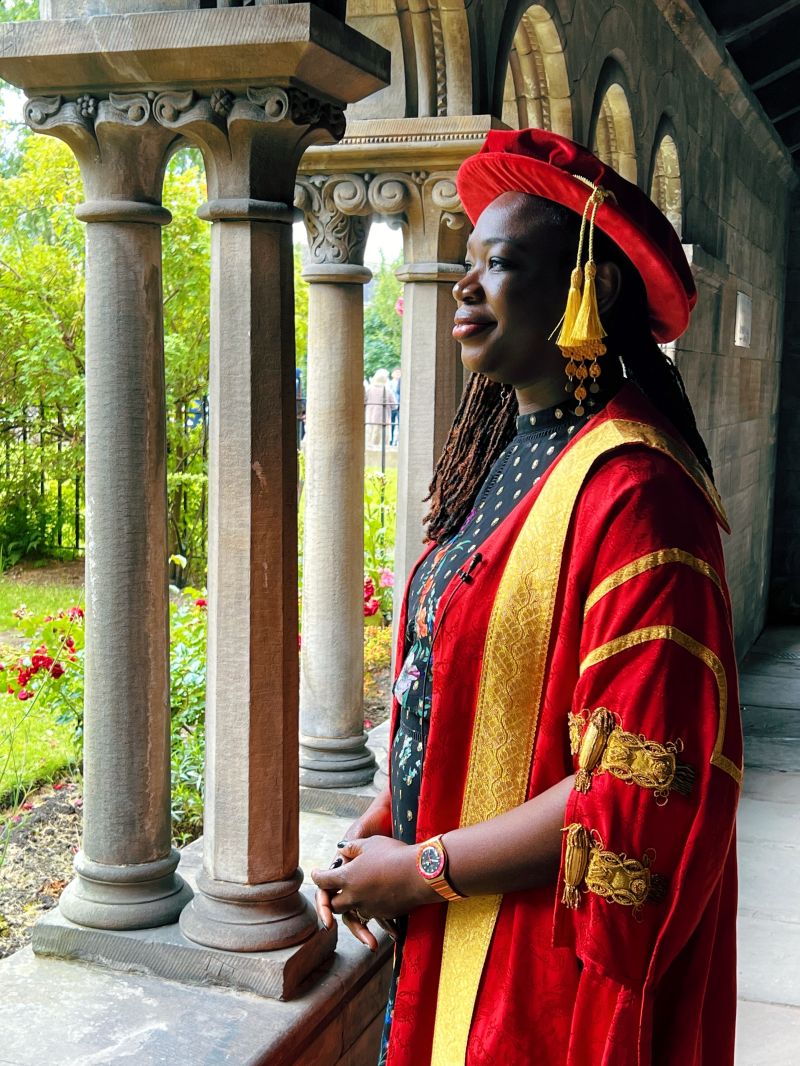
She trained as a chemical engineer in Benin City, sold oilfield technology in Aberdeen and built a marketing business from scratch. Now Dr Yekemi Otaru presides over one of Scotland's largest universities, and a small Kwara town is claiming her as its own.
When Yekemi Otaru was formally installed as Chancellor of the University of the West of Scotland at Paisley Abbey in June 2022, the ceremony carried the usual trappings of academic tradition: gowns, a procession, students' music and poetry beneath the medieval vaults. It also carried a significance that went well beyond Paisley. She was the first woman of colour to hold the post, and her appointment was widely reported as making her the first Black woman to serve as chancellor of a Scottish university.
Four years into the role, her story is still told with particular pride more than 3,000 miles away in Ayedun, a community in the Oke-Ero Local Government Area of Kwara State, where her father's family has its roots.
A childhood across three cities
Born Yekemi Awoseyin, she is the eldest of three children of Dr Raphael Sunday Awoseyin, an indigene of Ayedun, and Mrs Sarah Olubunmi Awoseyin, whose family comes from Iya-Gbede in Ijumu Local Government Area of Kogi State. It was a household in which education was expected rather than encouraged.
Her schooling was unusually itinerant. She began at Auntie Rose Primary School and Federal Government College in Warri, Delta State, before the family moved to Muscat, Oman, in 1990, where she attended the American British Academy. She returned to Nigeria to finish her secondary education at Greater Tomorrow Secondary School in Benin City. The moves exposed her early to different cultures and classrooms, a grounding that would serve her well in an international career.
From the oilfield to the boardroom
She enrolled at the University of Benin to read Chemical Engineering in 1997 and graduated in 2002 with a Second Class Upper. During her National Youth Service year she joined a postgraduate petroleum engineering programme run by TotalFinaElf with the Institut Français du Pétrole and the University of Port Harcourt, and was one of only six graduates from that pioneer set offered permanent jobs by the company.
In 2004 she moved to Aberdeen, the capital of Britain's North Sea oil industry. After starting with Total, she joined Schlumberger, now SLB, where she worked across engineering, technical sales and business development. It was there that she discovered a taste for the commercial side of the business, which led to marketing and strategy roles at Baker Hughes and Lloyd's Register. She sharpened that shift with an MBA from Henley Business School, gained with distinction, one of the four degrees she now holds.
In 2016 she struck out on her own, founding YO! Marketing and publishing The Smart Sceptic's Guide to Social Media in Organisations, on how organisations can put social media to effective use. The same year Scottish Business News named her among its top 40 business innovators under 40.
She went on to co-found Doqaru, an Aberdeen sales and marketing consultancy, with Sarah Downs. The pair were named Social Entrepreneur of the Year at the Scottish Women's Awards in 2022, and she was Services Industry Entrepreneur of the Year at the Great British Entrepreneur Awards in 2023. Through YO Ventures she continues to mentor start-ups and small businesses, with a particular interest in women founders and entrepreneurs in some of the world's poorest countries.
A seat at the head of the university
The University of the West of Scotland announced her as Chancellor-elect in 2021, when she was 42. She took office on 1 September that year, succeeding Dame Elish Angiolini, the former Lord Advocate. At her installation the following summer she was also awarded an honorary doctorate.
UWS, formerly the University of Paisley, has more than 15,000 students across campuses in Paisley, Lanarkshire, Dumfries, Ayr and London, and has long prided itself on widening access to higher education. A chancellor's role is largely ceremonial and ambassadorial: conferring degrees, presiding at graduations and representing the university at home and abroad. Day-to-day management rests with the Principal and Vice-Chancellor.
But the symbolism is not trivial. For students from minority and less privileged backgrounds, the sight of an African woman engineer handing out their degrees sends a message that no prospectus can.
From enterprise to charity
In 2024 her career took another turn. When Brian and Jenny Taylor, who founded the Aberdeen charity Somebody Cares in 2002, retired after 22 years, she stepped in as interim chief executive and was later confirmed in the post. The charity supplies food, clothing, furniture and household essentials to people in hardship, and helps more than 13,000 people across Aberdeen and Aberdeenshire.
It is a long way from selling oilfield services. Yet the thread is consistent: each move has taken the skills of the last and turned them to a new purpose, first engineering to sales, then sales to enterprise, and now enterprise to public service.
A lesson for Ayedun
For Ayedun, her rise is more than a source of local pride. The community has been turning its attention to education, most visibly through the Ayedun Educational Summit, which brings together residents, professionals and the diaspora to discuss how to widen opportunity for the town's young people. Dr Otaru's career offers those discussions a vivid case study.
Its first lesson is that a degree is a beginning rather than a destination. She has reinvented herself at least four times, each time by learning something new: an MBA in mid-career, a move from engineering into marketing, from marketing into business ownership, and from business into charity leadership. In a labour market being reshaped by automation and artificial intelligence, that capacity to keep learning may matter more than any single qualification.
The second concerns girls and science. Women remain under-represented in engineering in Nigeria as in Britain. A chemical engineer from Kwara who now confers degrees in Scotland is a powerful answer to any girl told that the laboratory, or the boardroom, is not for her.
The third is about connection. Nigerians abroad possess expertise, networks and experience that their home communities can ill afford to waste. Structured mentoring, guest lectures delivered online and partnerships with schools could turn diaspora success stories into practical help.
Dr Otaru's journey from Warri classrooms to Paisley Abbey is, in the end, a story about what education makes possible when it is combined with ambition, adaptability and a willingness to serve. Ayedun, and Nigeria, would do well to make sure it is not the last of its kind.
Related in Education
Keeping girls in the classroom: the Wellbeing Foundation's quiet revolution
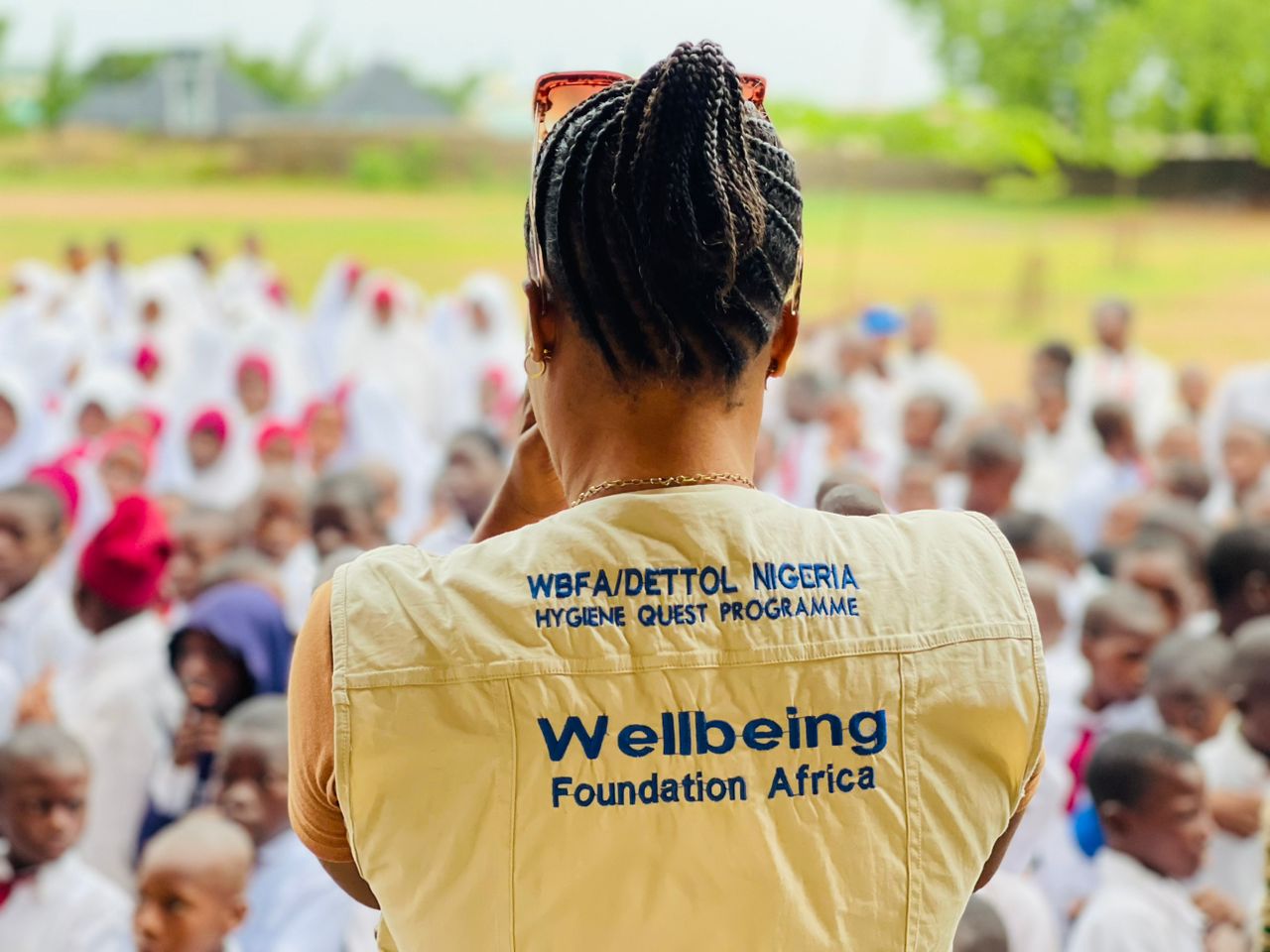
A 2025 study found that more than half of school-age girls in Nigeria miss school each month because sanitary products are unaffordable or unavailable. A girl who misses a week every month will, sooner or later, stop going at all. Founded in 2004 by Toyin Ojora Saraki as a maternal health charity, the Wellbeing Foundation Africa has built its work for girls on that insight. It runs school programmes on menstrual hygiene, nutrition and girls’ rights, and by its own account its Hygiene Quest curriculum has reached 57,900 girls in schools. The aim is that no Nigerian girl should have to choose between her dignity and her desk.

When the moon stopped talking: Africa's lost classroom of values
For generations, African children learnt right from wrong not from textbooks but from a grandmother’s voice under the full moon. Through the greedy tortoise and the cunning spider, they absorbed honesty, respect for elders and loyalty to the community, often without anyone spelling out the moral. Urbanisation, television, smartphones and the retreat of African languages have since silenced that nightly classroom. The moon still rises over every village and city. What is missing is the circle beneath it.

Can a screen fill Africa's empty teacher's desk? 18 Oct 2026 · @Richard Awoseyin
Sub-Saharan Africa needs 15 million more teachers by 2030, more than any other region, and it cannot train them fast enough. But a shortage of teachers is really a shortage of teaching, and teaching can travel. In Ghana, live satellite lessons from a studio in Accra raised rural pupils’ maths scores by about a quarter of a standard deviation. In Botswana, a weekly text message paired with a 20-minute phone call cut innumeracy by 31 per cent. Virtual classrooms will not replace Africa’s missing teachers. Used wisely, they can make every good one go much further.